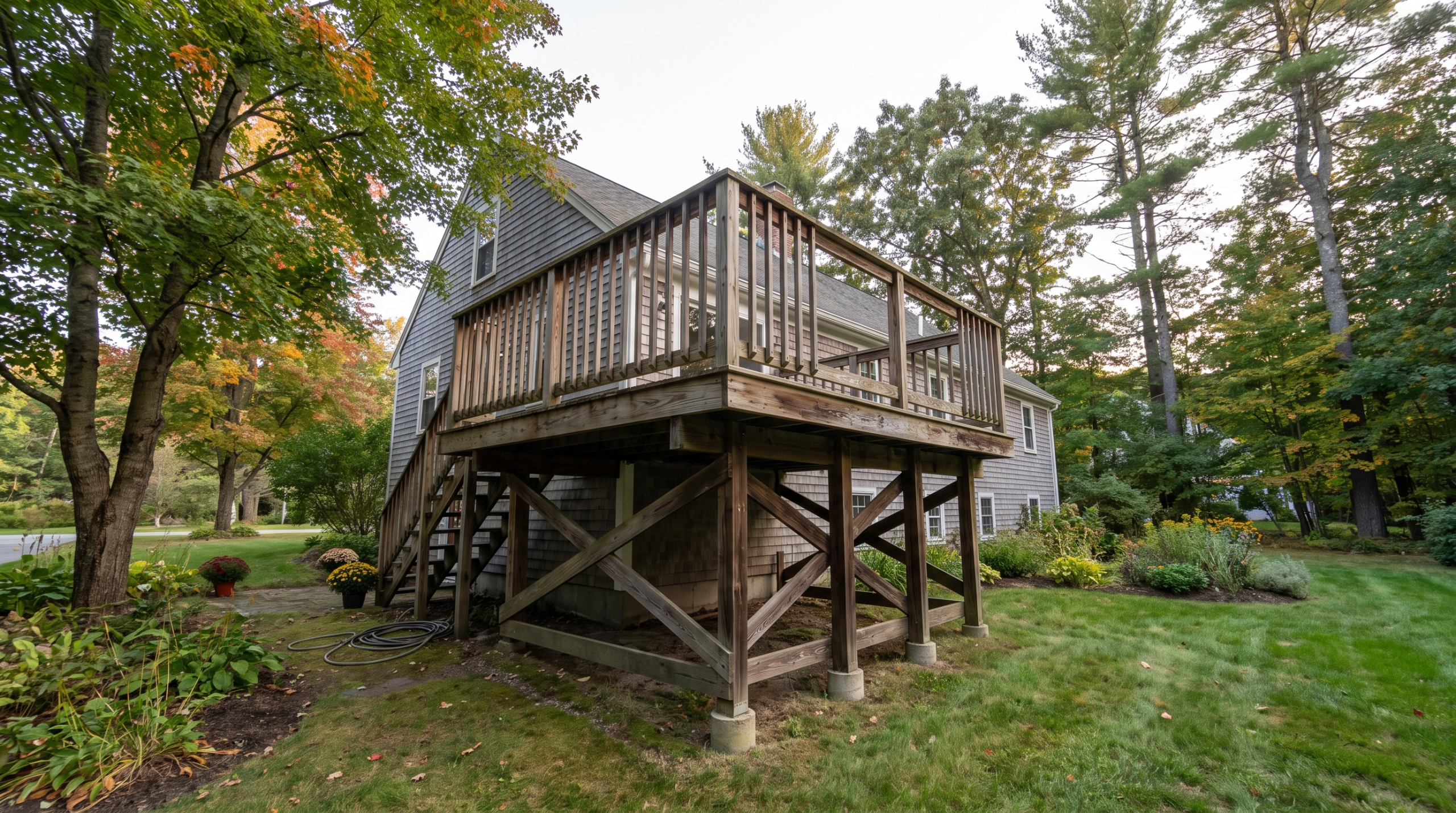
When comparing deck resurfacing vs. replacement, resurfacing is usually appropriate only when the framing, footings, ledger, stairs, and guard system are sound. If deterioration reaches those structural parts, replacing the deck—or rebuilding a substantial section—is the safer planning assumption. The finish on top can hide very different conditions underneath, so the first decision is not wood versus composite. It is surface project versus structural project.
Start with the load-bearing structure, not the boards
A deck is a system. The visible boards are supported by joists, beams, posts, footings, fasteners, and the connection to the house. Resurfacing typically replaces the walking surface and may replace rail components while leaving much of that system in place. Replacement changes enough of the system that the project should be planned as a rebuild.
| What you observe | What it may mean | Best next step |
|---|---|---|
| Worn finish or checked boards, but framing and connections appear sound | The problem may be concentrated at the surface | Ask for a resurfacing inspection and a board-by-board scope |
| Localized soft boards or damaged rail components | A limited repair may be possible, but hidden conditions still matter | Price the repair only after the supporting area is inspected |
| Movement at posts, stairs, guards, or the house connection | The issue may extend beyond decking | Stop using the affected area and request a structural evaluation |
| Widespread decay, corrosion, undersized framing, or failing footings | The existing structure may not be a dependable base for new boards | Plan around replacement or a substantial rebuild |
| You want a larger footprint, different stairs, or a new layout | The project changes structure and circulation, not just finishes | Treat it as a redesign and replacement project |
This table is a screening tool, not a structural diagnosis. A qualified contractor should verify conditions that are concealed, difficult to reach, or tied to the house.
What deck resurfacing can—and cannot—fix
Resurfacing can renew a deck when its supporting structure still has useful service life. A typical scope may include removing deck boards, inspecting accessible framing, correcting limited blocking or hardware issues, installing new decking, and rebuilding selected rail sections. The exact scope should identify what stays, what is replaced, and what happens if concealed damage appears after demolition.
Resurfacing does not correct a compromised ledger, settling footings, badly decayed joists, or a layout that no longer works. Covering those issues with new boards can make the deck look finished without resolving the reason it needs attention.
Signs that support a resurfacing conversation
- The deck feels stable under normal use, with no obvious movement at stairs or rails.
- Deterioration appears limited to the boards or a small number of components.
- Joists and beams are accessible enough to inspect after boards are removed.
- The existing size, stair location, and traffic flow still suit the household.
- The proposed decking is compatible with the existing joist spacing and fastening plan.
Conditions that push the project toward replacement
- Softness or decay is visible across multiple structural members.
- Posts lean, footings have moved, or framing has pulled away from the house.
- Fasteners and connectors show extensive corrosion.
- Guards or stairs move because their supporting framing is weak.
- The current deck must be enlarged, reconfigured, or brought into a substantially different design.
Why New Hampshire exposure changes the conversation
Exterior wood in Londonderry cycles through rain, snow, sun, and seasonal humidity. The U.S. Forest Service explains that wood decks take heavy weather exposure and that repeated shrinking and swelling can contribute to checking, warping, and moisture-related deterioration. Its guidance on finishes for wood decks is useful context for understanding why a worn surface deserves inspection rather than an automatic coat of stain.
Pay close attention where water can linger: board ends, stair stringers, the tops of joists, rail-post connections, and the area where the deck meets the house. Shade and trapped debris can make one section age differently from another, which is why a single attractive photo rarely tells the whole story.
A practical inspection sequence before choosing a scope
- Map the symptoms. Note soft boards, loose rails, staining, standing water, uneven stairs, and any movement. Photograph both the surface and the framing below.
- Separate cosmetic wear from movement. Fading and surface checking are different from a post, stair, or guard that shifts under light pressure.
- Inspect the water path. Look for places where debris collects or runoff reaches framing and connections.
- Review the house connection. Ask the contractor how the ledger, flashing, and fasteners will be evaluated. Do not assume this area is sound because the deck boards look acceptable.
- Confirm compatibility. New decking products may require specific joist spacing, ventilation, fasteners, or framing corrections.
- Write an allowance process. The proposal should explain how concealed conditions will be documented, priced, and approved before extra work begins.
Choose finishes only after the structure is understood
Once the deck qualifies for resurfacing, compare finish materials in the context of the existing frame. Wood boards offer a familiar look and can be refinished, but they require an ongoing maintenance plan. Composite boards reduce some surface maintenance, but they do not make old framing, weak connections, or poor drainage disappear. Color, heat in direct sun, expansion requirements, railing compatibility, and fastening details all belong in the product decision.
If the deck needs replacement, the design discussion can go further: stair direction, landings, door clearances, furniture zones, lighting, privacy, and how people move between the house and yard. New England Home Pros’ custom deck service shows the broader design-and-build context for that kind of project.
Check permit requirements before the start date
Permit requirements depend on the actual scope and local review. The Town of Londonderry’s residential building permit page lists separate application materials for decks and for residential projects. Confirm the current requirements with the local building department before work begins, especially when the project changes framing, guards, stairs, footings, or the deck footprint.
Bring this information to the estimate
- Wide photos of every side plus close photos of problem areas
- Approximate deck dimensions and stair count
- The age of the deck, if known, and a history of repairs or coatings
- Locations where water, snow, or debris tends to collect
- Your preferred surface material and whether the layout should change
- Any timing constraints that affect permitting or material selection
A useful proposal should state the assumed condition of the existing frame, the inspection steps after boards come off, the exact components included, and the change-order process. That makes resurfacing and replacement bids easier to compare on the same basis.
Make the decision from verified conditions
The economical choice is the one that matches the structure you actually have. Resurfacing a sound frame can concentrate the budget where it is needed. Replacing a deck with widespread structural problems avoids investing in a surface that outlasts its support. If you want help documenting the condition and defining a clear scope, request an estimate from New England Home Pros in Londonderry, New Hampshire.