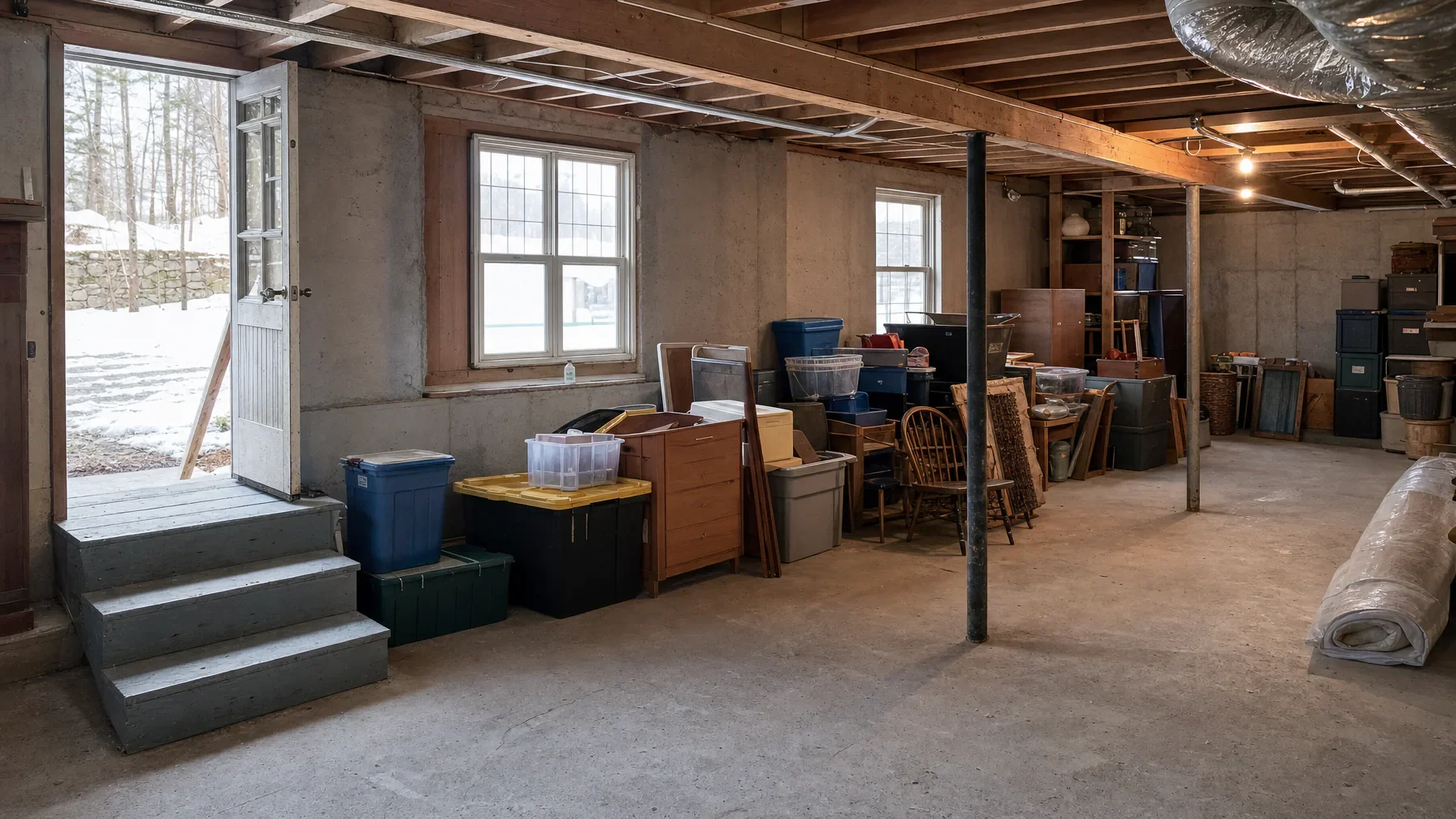
Once your basement remodeling scope is agreed, clearing the space becomes a coordination task: confirm what must leave, decide where it will go, and record who will move it. Work zone by zone rather than moving everything into another corner that may also need to be available for construction.
The goal is to transfer stored contents out of the agreed work area while keeping needed belongings accessible. An empty-looking basement is not the same as a space your contractor has confirmed is ready for work.
Confirm the work boundaries before moving belongings
Ask your contractor to identify the areas that must be cleared, including any space outside the remodeled rooms needed for entry, material handling or equipment access. Do not assume an unfinished storage room or a corner beyond the planned walls can hold everything that comes out.
- Confirm which rooms, closets, shelves and other storage areas must be emptied.
- Ask whether freestanding shelving, furniture and wall-mounted belongings must be removed or discussed separately.
- Identify any proposed storage area within the basement and obtain agreement before placing belongings there.
- Agree on when homeowner clearing needs to be complete and how unresolved items will be reported.
Sort by destination, not just by what you want to keep
A keep pile still needs a destination. Before packing, separate belongings according to how they will leave the work area and whether you will need them during construction. Keep sorting within the area you are clearing rather than spreading open boxes across access routes.
- Keep accessible: Move belongings you expect to use into a household-accessible location outside the work zone. Avoid burying them behind long-term storage.
- Temporary storage: Pack belongings you can set aside, then choose an agreed location suited to their storage needs. Check that you can reach them if plans change.
- Donation: Confirm that the receiving organization accepts the items and arrange their actual departure. A labeled donation pile still occupies the work area.
- Disposal: Separate ordinary unwanted contents from anything needing special handling. Confirm local disposal requirements and who will arrange removal.
Before choosing a temporary storage destination, ask: Where will these belongings fit? Will you need to retrieve them during construction? Who will move them there and back? For storage at home, confirm the proposed location with the contractor and check household routes before moving boxes. For storage elsewhere, ask the provider about access arrangements and whether the space is suitable for the belongings you intend to store.
Clear the basement zone by zone
Use the basement’s existing rooms or recognizable storage areas as your checklist. Finish packing, labeling and transferring the ordinary contents of an area before opening another. Record anything left behind instead of treating it as someone else’s task.
- Shelves and closets: Which contents are designated for removal, and where will they go? Has the contractor confirmed whether the shelving itself must remain or be removed?
- Furniture and hobby areas: Which loose belongings still need packing? Who will arrange handling for each bulky piece?
- Laundry and equipment areas: Which stored belongings can you safely reach? Which connected items need a handling plan from the contractor or an appropriate professional?
- Stairs, landings and entrances: Have stored belongings been removed from the agreed carrying route? Where will packed containers go instead of waiting on that route?
- Approved remaining storage: Has the contractor agreed to the location and its boundaries? Are any contents outside those boundaries still awaiting relocation?
Label containers and keep a belongings log
Label each container with its contents and destination, using the same wording in a shared paper or digital log. Keep labels visible after stacking. Separate frequently needed belongings from items that can remain packed, even when they normally share a shelf.
Use these fields for each container, bulky item or group of belongings:
- Item or container: A recognizable description matching the label.
- Destination: The actual room, storage location, donation destination or disposal arrangement—not simply “elsewhere.”
- Needed during the project: Yes, no or uncertain. Resolve uncertain items before placing them out of reach.
- Person responsible: The person arranging packing, moving or removal, with any handoff noted.
Update the destination when an item actually moves. If a container changes location, change the log rather than relying on memory. Mark unresolved items as awaiting a decision so they do not disappear into a general packing list.
Coordinate bulky, attached or connected items
Set aside a discussion list for items whose handling is not straightforward. Include heavy furniture, large exercise equipment, attached shelving and connected appliances. Tell the contractor where each item is, whether you want to retain it and whether a destination has been arranged.
Note Clearing stored belongings does not include disconnecting equipment, moving connected appliances, removing building materials or performing demolition. Do not disturb suspect hazardous materials or move questionable containers. Leave them undisturbed and ask about appropriate professional handling.
Confirm who will arrange any needed mover, qualified trade professional or disposal provider. Do not assume moving, storage, cleanup or disposal is included in the remodeling agreement. If an item cannot be removed as planned, notify the contractor before the agreed clearing deadline.
Check access routes after storage is relocated
Walk the agreed entry and carrying route after relocating belongings. Check both ends of the move: clearing the basement has not solved the problem if boxes now obstruct the entrance, hallway or destination room.
Ask the contractor to confirm areas that must remain available for equipment access, material handling and household circulation. Also confirm whether you will be able to reach any belongings left in approved basement storage. Do not plan on entering the work zone to retrieve them without an agreed arrangement.
If relocating contents reveals a wider conflict between household access and construction access, revisit the decision guide to living at home during a remodel. A storage plan should support that arrangement, not undermine it.
Complete a pre-start clearance confirmation
Before handing the area over, compare its condition with the agreed clearing plan. Send the contractor a concise update identifying what is complete and anything still awaiting action.
- The agreed work areas are free of the stored contents designated for removal.
- Containers are labeled, their destinations are logged and needed belongings are accessible outside the work zone.
- Donation and disposal items have left, or remaining removal arrangements have been explicitly accepted.
- Every remaining bulky, attached or connected item has an agreed handling plan and responsible person.
- Work boundaries, access routes and any remaining storage locations have been confirmed with the contractor.
New England Home Pros specializes in basement finishing and remodeling. For your agreed project, confirm the clearance expectations and unresolved belongings directly with the team. Completing your contents checklist is a handoff for contractor confirmation—not approval that construction can begin.